How to Purchase Adult Traffic in 2026: Networks, Real Costs and the Mistakes That Eat Budgets
Most people who decide to purchase adult traffic spend their first few hundred dollars learning things that could have been written down. Which formats convert. Which GEOs are cheap because nobody wants them. Why a campaign that looked profitable on day one was actually buying bots from three sub-IDs you never blacklisted.
This guide is that written-down version. Where adult traffic is sold, what it costs, how the buying process actually works step by step, and — the part most guides skip because they’re published by the networks selling it — when buying traffic is the wrong move entirely.
No affiliate links, no network we get paid to recommend. We make distribution software, not ad inventory, so we have no reason to talk you into a deposit.
What You’re Actually Buying When You Purchase Adult Traffic
“Adult traffic” is visitors to adult websites — tubes, cam sites, dating platforms, paysites — sold to advertisers as impressions, clicks or views. The inventory comes from publishers who have more visitors than they can monetize themselves, and it reaches you through an ad network, a broker, a DSP, or occasionally the publisher directly.
(People search for this half a dozen ways — buy adult web traffic, buy porn traffic, adult traffic buy, adult website traffic. It’s all the same transaction. We’ll use “purchase adult traffic” throughout so the terminology stays out of the way.)
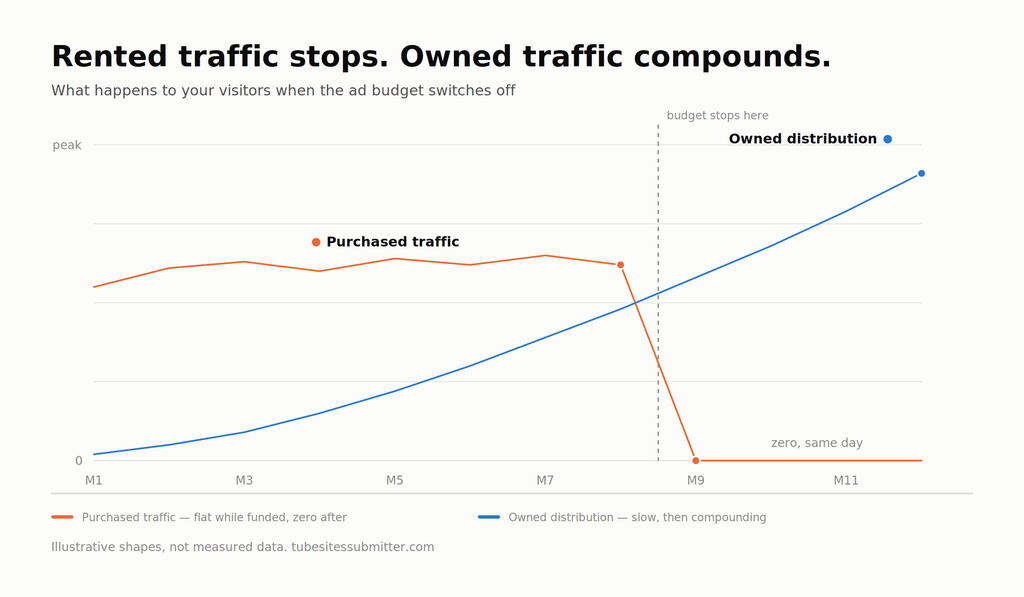
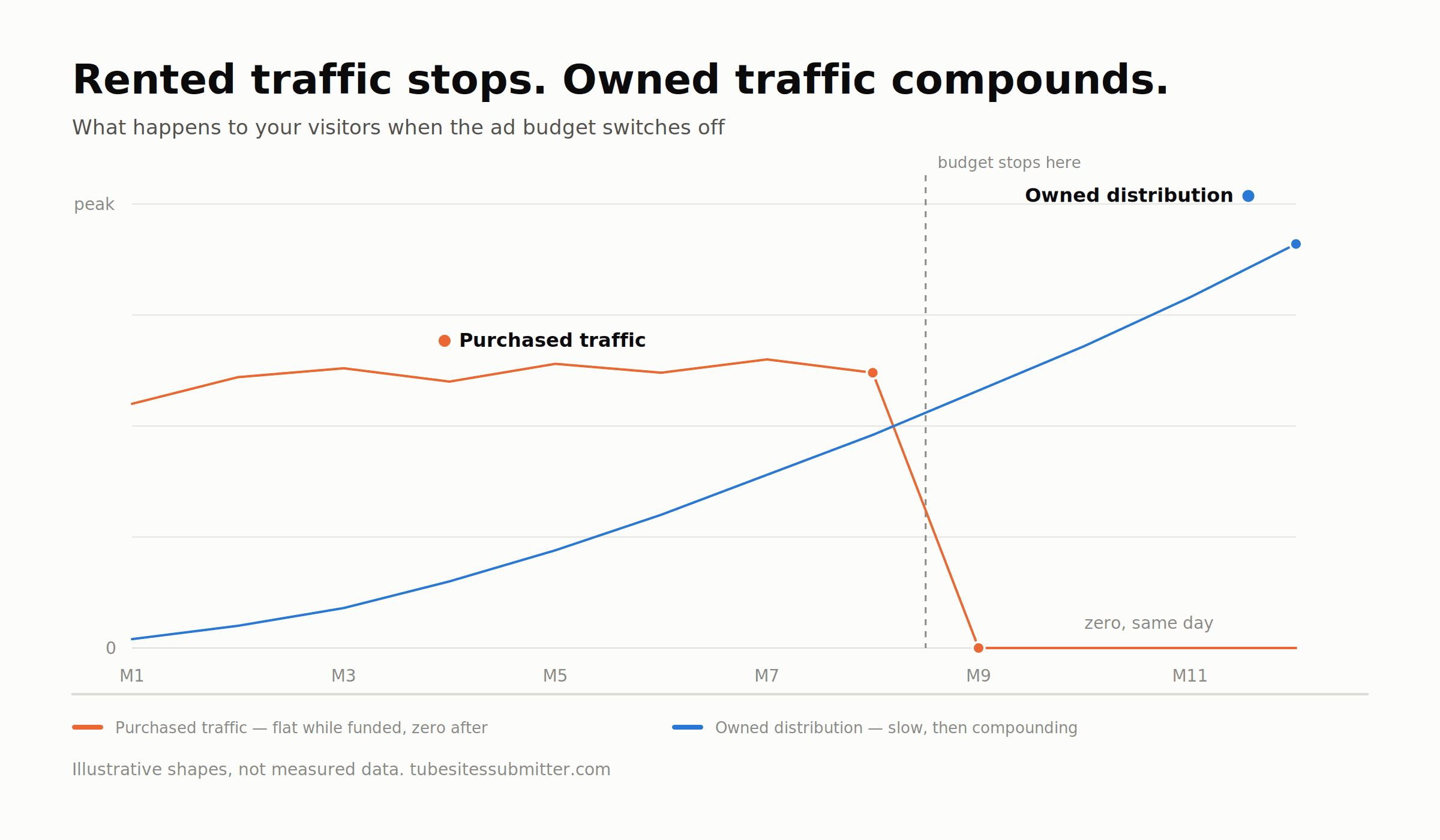
The important thing to understand up front: you are renting attention, not building an audience. The moment your budget stops, the traffic stops. That’s not an argument against buying it — rented traffic is fast, testable and scales in an afternoon, which owned channels never do. But it changes what a good campaign looks like. If you’re buying traffic that doesn’t either convert immediately or capture something durable (an email, a Telegram subscriber, a push opt-in, a signup), you’re paying rent on an empty apartment.
The formats you’ll actually be choosing between
| Format | How it works | Typically used for | Reality check |
|---|---|---|---|
| Popunder / Pop | New window or tab opens behind the page | Dating, cams, VPN, sweeps, app installs | Cheapest volume anywhere. Also the lowest intent and the most fraud-prone. Great for testing offers, brutal for branding. |
| Push / In-page push | Notification-style ad to opted-in users | Dating, cams, nutra, gambling | Subscriber lists age. Ask the network how old the list is — “fresh” and “3 years old” perform nothing alike. |
| Banner / Display | Standard IAB placements on tube and cam sites | Brand, retargeting, paysite promos | Banner blindness is real in adult. Works on premium placements, wastes money on remnant. |
| Native | Ad blends into the site’s content grid | Content offers, quizzes, pre-landers | Higher CTR than banners, more creative work required. |
| Video pre-roll | Plays before tube content | Cams, paysites, high-ticket offers | Highest intent on the list. Highest price too, and the biggest networks gate it behind large minimums. |
| Members area / email | Inventory behind a paywall or in a mailing list | Rebills, upsells, high-LTV offers | Small volume, strong quality, often sold direct rather than self-serve. |
| Domain redirect | Parked or expired adult domains push visitors to you | Volume plays, arbitrage | Cheap. Verify the source, or you’ll buy your own retargeting pixel back. |
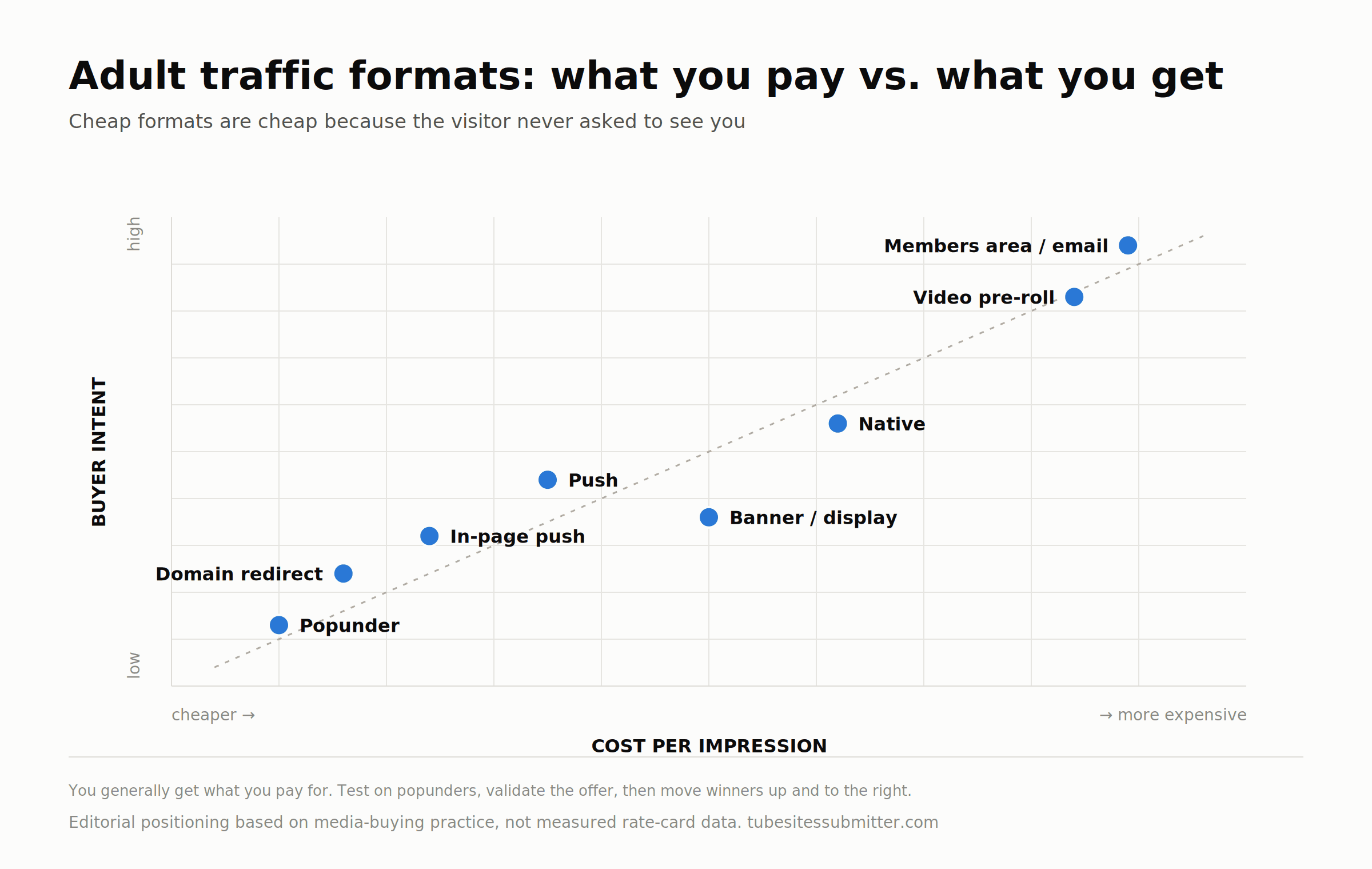
If you’re new, the honest sequence is: test on pops, validate the offer, then move the winners to push and pre-roll. Pops are cheap enough to be a laboratory and too low-intent to be a business.
Where to Purchase Adult Traffic: Four Routes
1. Adult ad networks (where almost everyone starts)
Self-serve platforms with a dashboard, a deposit, and inventory aggregated from thousands of publishers. You pick format, GEO, device and bid, and you’re live in an hour.
Here’s a snapshot of the better-known adult ad networks and what they ask for to get started. Minimums and formats change — confirm on the network’s own site before you budget around these.
| Network | Formats | Min. deposit | Pricing model | Best known for |
|---|---|---|---|---|
| ExoClick | Display, native, video, push, pops, in-stream | ~$200 | CPM, CPC, SmartCPM | Biggest self-serve adult platform; deep reporting |
| TrafficJunky | Display, video pre-roll, native | ~$100 | CPM, CPC | Exclusive access to the Aylo/Pornhub network |
| TrafficStars | Banners, native, video, push, pops, interstitial | ~$100 | CPM / CPMV | High-volume premium adult inventory |
| JuicyAds | Banners, native, popunders, float, in-video | ~$50–100 | RON and direct buys | Direct publisher marketplace; long track record |
| TrafficFactory | Banners, video pre-roll | ~€300 | CPC only | Exclusive xvideos / xnxx inventory |
| ClickAdilla | Multi-format | ~$50 | Micro-bidding | Granular micro-bidding, 200+ GEOs |
| PopAds | Popunders only | ~$10 | Smart bidding | Lowest entry point anywhere; pops only |
| Evadav | Push, pops, in-page, native | ~$100 | CPC / CPM / SmartCPM | Large push subscriber base |
| AdMaven | Push, pops | ~$50 | CPM | High share of direct-publisher supply |
| PlugRush | Push, display, pops, native | ~$50 | CPV | Sub-source level optimization |
| TwinRed | Pops, push, native, interstitial | Contact | Real-time bidding | Premium Tier-1 inventory, second-price auction |
| Zeropark | Push, pops, domain redirects | ~$200 | CPV / CPC | Native Voluum integration, rule-based rules engine |
What this table actually tells you: the barrier to entry is $50–$200, not $5,000. Which means the constraint on your first campaign isn’t money — it’s whether you’ve set up tracking before you spend it.
Networks are also where most people buy adult web traffic for the first time precisely because they hide the messy part: you never negotiate with a publisher, you just bid. The cost of that convenience is that you don’t know whose site you’re on until you read the sub-ID report.
A practical note on picking your first one: if your budget is under $100, PopAds and ClickAdilla have the lowest barriers. If you specifically want the Pornhub/Aylo network, that’s TrafficJunky and nowhere else. If you want xvideos and xnxx, that’s TrafficFactory. For everything else in one dashboard, ExoClick and TrafficStars are where most media buyers end up.
2. Direct publisher deals
You negotiate with a tube or cam site directly for placements. Better quality, no middleman margin, real control over where you appear. The trade is volume commitment: most publishers worth buying from want meaningful monthly spend before they’ll give you a rate card, and you’ll be managing each relationship by hand.
Worth doing once you know exactly which sites convert — which you only learn by buying network traffic first and reading your sub-ID reports.
3. Brokers and resellers
Someone else’s inventory, marked up. Sometimes legitimately useful for hard-to-reach GEOs or exclusive placements. Often it’s network traffic with a second margin stacked on it. Ask one question: whose inventory is this originally? A broker who won’t answer is a broker you don’t need.
4. Programmatic / DSP
Real-time bidding across adult supply through a demand-side platform. Granular targeting, proper frequency capping, audience segments. It’s the most sophisticated way to purchase adult traffic and the least forgiving — you need volume, a tracking stack and someone who knows what they’re doing, or you’ll optimize toward noise.
What Adult Traffic Costs
There’s no universal rate card, and anyone publishing one is guessing. Price is set by four things, in this order:
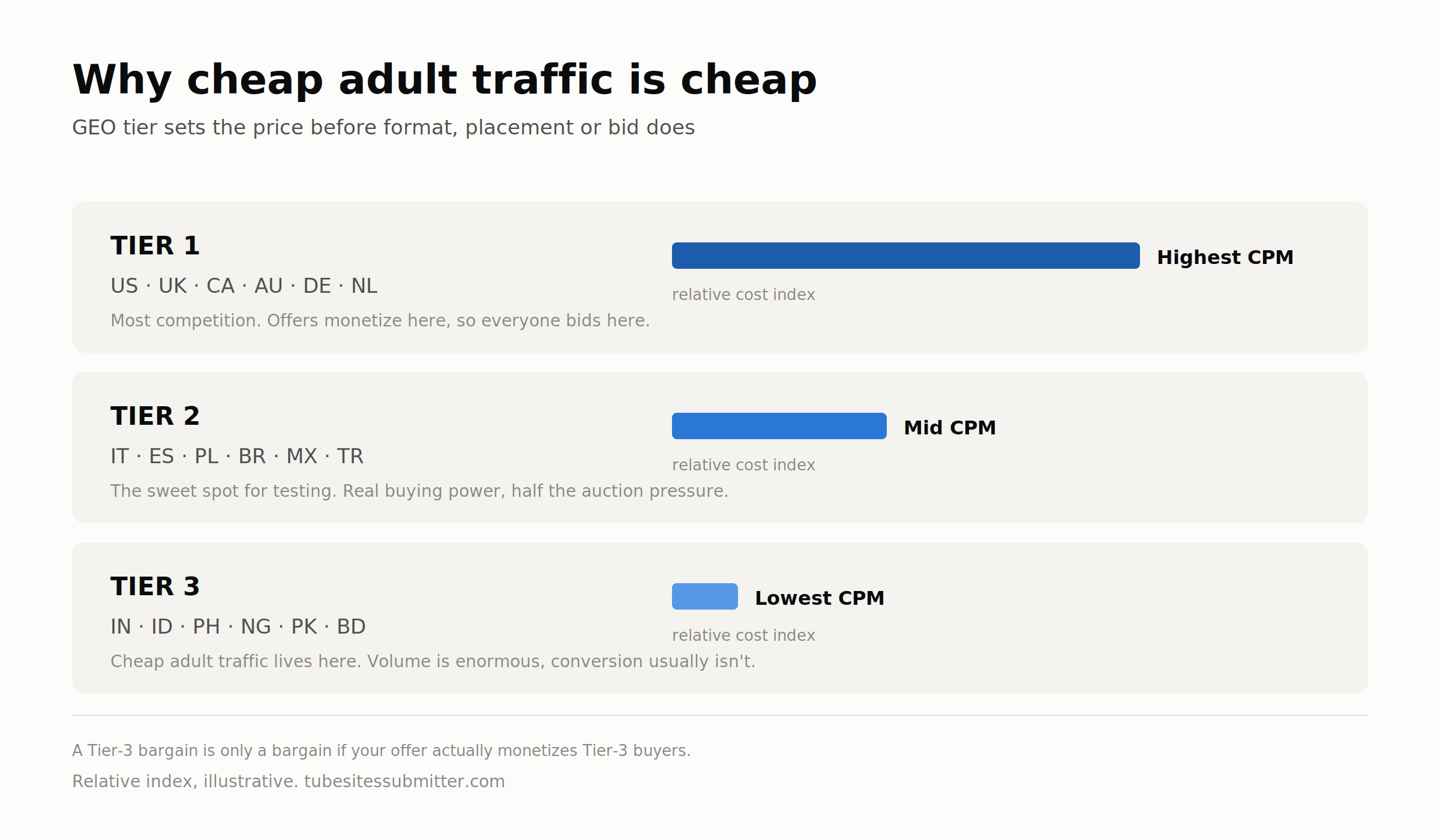
1. GEO tier. Tier-1 (US, UK, CA, AU, DE) costs multiples of what Tier-3 costs, because the buyers converting there are paying more per conversion. Cheap adult traffic is almost always cheap because it’s from a GEO where nobody’s offer monetizes — that’s not a bargain, it’s a different business.
2. Format. Rough ordering, cheapest to most expensive: popunder → in-page push → push → banner → native → video pre-roll → members area.
3. Placement quality. Premium slots on a major tube cost several times what remnant inventory on a long-tail site costs. Sometimes it’s worth it. Your sub-ID report will tell you which.
4. Competition in your vertical. Dating and cams bid aggressively. Niche verticals get in cheaper.
Pricing models, and which one to pick
- CPM — pay per 1,000 impressions. Predictable, and the default for most adult inventory. You carry the risk on click-through.
- CPC — pay per click. Risk shifts to the network. Usually a higher effective cost.
- CPV / CPMV — pay per view or viewable impression. Common for pops and video.
- SmartCPM / smart bidding — you set a max, the system pays only what’s needed to win the auction. Use this when it’s available. Manual CPM bidding against an auction you can’t see is a slow way to overpay.
- CPA — pay per conversion. Rare, restricted to proven advertisers, and the network prices the risk into it.
Budget tiers: what your money actually gets you
| Daily budget | Realistic scope | What to do |
|---|---|---|
| $20–50/day | One GEO, one format, 2–3 creatives | Testing only. Don’t expect profit; expect data. Pops or in-page push. |
| $50–200/day | 2–3 GEOs, two formats, active blacklisting | This is where optimization starts working. Run pre-landers. |
| $200–1,000/day | Multi-format, multi-GEO, whitelists built from real data | Scale winners. Consider direct deals for your top 5 sources. |
| $1,000+/day | Programmatic, direct publisher contracts, dedicated AM | You need someone whose full-time job this is. |
Rule of thumb for a first test: budget 3–5× your target CPA per campaign before you judge it. If you want conversions at $20 and you spend $30 total, you haven’t tested anything — you’ve bought a coin flip.
How to Purchase Adult Traffic: The Step-by-Step
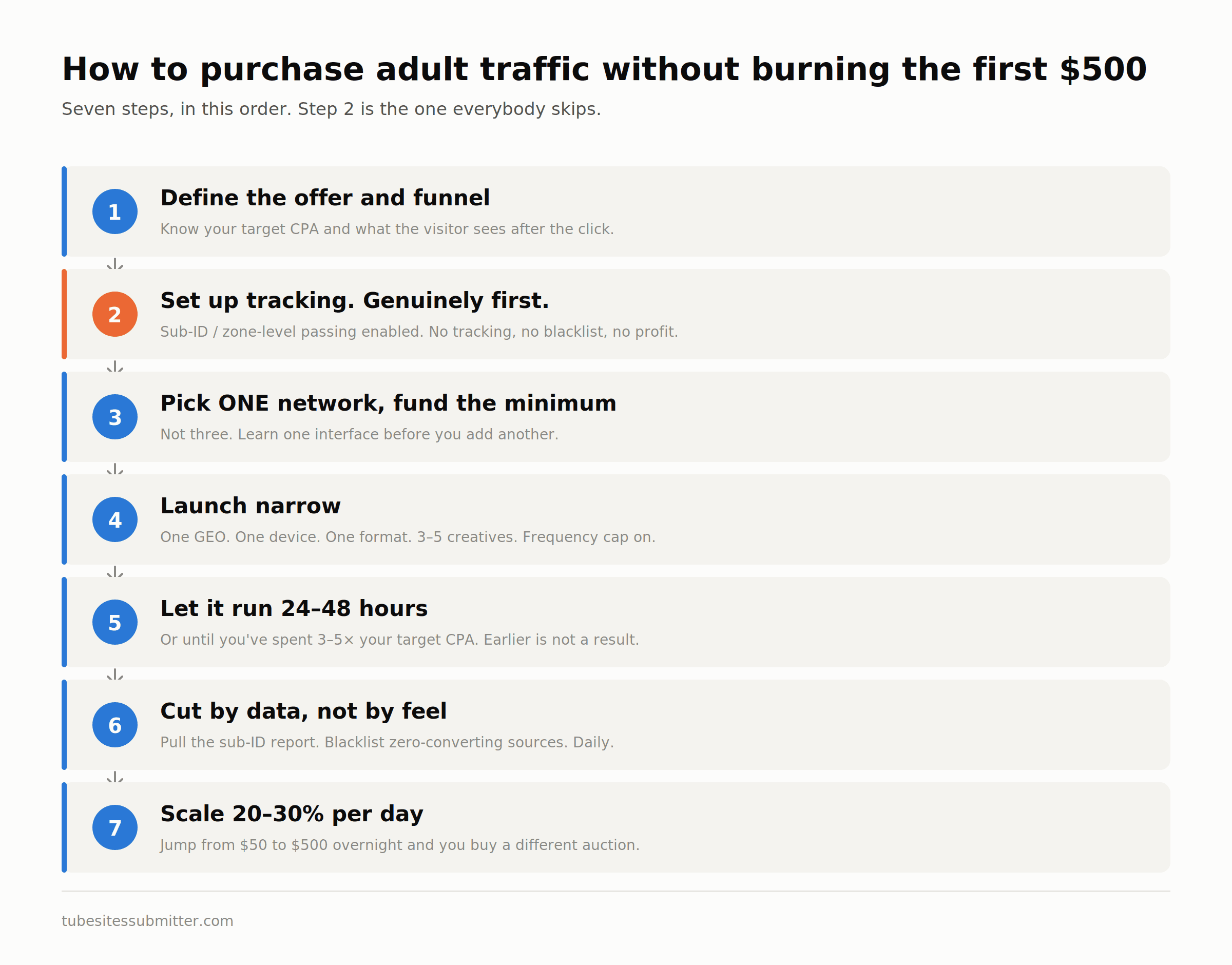
Step 1 — Have the offer and the funnel before you have the account
Know your target CPA, your payout, and what the visitor sees after the click. “I’ll figure out the landing page after I see if the traffic’s any good” is how people conclude that adult traffic doesn’t work.
Step 2 — Set up tracking first. Genuinely first.
A tracker — Voluum, Binom, Keitaro or RedTrack, or your own — with sub-ID / zone-level passing enabled. Without per-source data you cannot blacklist, and without blacklisting you’re funding whichever placement has the most bots.
Cloud trackers (Voluum, RedTrack) are faster to start; self-hosted trackers (Binom, Keitaro) cost less at volume and keep your data on your own server, which matters more in adult than in most verticals.
This is the single step that separates buyers who become profitable from buyers who quit. Do not skip it because you want to see traffic flowing today.
Step 3 — Pick one network and fund the minimum
Not three networks. One. Learn its interface, its approval process, its reporting quirks. Start with the smallest deposit it allows.
Step 4 — Launch narrow
One GEO. One device type. One format. Three to five creative variants. Frequency cap set — on pops, 1 per 24h per user is a sane default.
Broad targeting on your first campaign guarantees you’ll have a result you can’t explain.
Step 5 — Let it run long enough to mean something
24–48 hours minimum, or until you hit 3–5× target CPA in spend. Pausing after two hours because “it’s not converting” tells you nothing except that you’re impatient.
Step 6 — Cut by data, not by feel
Pull the sub-ID report. Blacklist sources with spend and zero conversions. Whitelist the ones converting above target. Kill losing creatives, duplicate winners with one variable changed.
Run this loop daily. Most profitable adult campaigns aren’t cleverly launched — they’re patiently pruned.
Step 7 — Scale slowly, one variable at a time
Raise budget 20–30% per day on winners. Jump from $50 to $500 overnight and you’ll be buying a completely different — and worse — slice of the auction.
Six Ways Buyers Lose Money (All Avoidable)
Buying volume instead of quality. A $0.30 CPM that converts at zero is infinitely more expensive than a $3.00 CPM that converts. Judge every source on cost per conversion, never on cost per impression. This is why “I bought a million visits for $200” is a sentence with no information in it — adult site traffic is only worth what it does after the click.
No blacklist, ever. Some percentage of any network’s inventory is fraudulent or worthless. That’s not a scandal, it’s the nature of aggregated supply. It only becomes your problem if you never cut it.
Sending cold traffic straight to the offer. A pop visitor did not ask to see you. A pre-lander that warms them up — a quiz, a comparison, a single qualifying question — routinely outperforms a direct link by a wide margin. Test it; don’t assume.
Creatives that ignore the network’s rules. Most adult networks don’t accept explicit nudity in creatives, even though the sites are adult. Suggestive converts anyway. Get your creatives rejected three times and you lose a week.
Ignoring compliance. Age verification, record-keeping obligations (18 U.S. Code § 2257 in the US), regional restrictions, and processor rules are all real and all enforced unevenly. If you’re running your own adult property rather than an affiliate offer, get proper legal advice — this article isn’t it.
Treating the first loss as the verdict. Almost every campaign loses money in its test phase. That’s what the test phase is for. The question isn’t “did it profit,” it’s “is there a subset of this traffic that profits.”
The Part Media Buyers Work Out Around Month Three
You’ve built something that works. Your CPA is under payout, your whitelist is tight, and every dollar in returns more than a dollar.
Then the network changes its algorithm. Or a big competitor enters your GEO and bid prices go up 40%. Or your card gets declined on a Friday.
And your traffic goes to zero the same day.
That’s the structural problem with paid media, and no amount of optimization fixes it: you don’t own any of it. You’re renting attention on a month-to-month lease with no notice period, and your cost per visitor only ever goes up, because every advertiser in the auction is bidding against you for the same inventory.
The counterweight isn’t to stop buying traffic. It’s to make sure buying isn’t your only channel.
Owned distribution: the other half of the equation
If you already produce video content, you own an asset that most media buyers don’t: something tube sites will host for free, keep indexed for years, and send you visitors from without an ongoing bill.
The arithmetic is straightforward. Say a realistic Tier-1 popunder rate on a self-serve network is around $2 CPM. A $35 monthly ad budget buys you roughly 17,500 impressions — pops, so figure single-digit-percentage engagement. That’s one campaign, one month, then it’s gone.
The same month, the same content published across 260+ tube sites stays there. Each upload is a page that can rank, get browsed, get embedded and keep sending visitors next year. It won’t produce a spike on Tuesday afternoon the way a bought campaign does. It compounds instead.
The reason almost nobody does this properly is time, not doubt. Uploading one video to one tube site takes roughly four minutes when nothing goes wrong — register or log in, upload, retype the title, rewrite the description, find the right categories, tag it, solve a CAPTCHA, wait. Across 260+ sites that’s most of a working week. Per video.
So people pick five or six sites and quietly pretend the other 250 don’t exist. Not because those sites don’t send traffic — because the math doesn’t work by hand.
Tube Sites Submitter is what makes it work: one upload distributed across 260+ tube sites and 200+ categories, automatic and manual account registration, unlimited profiles with a built-in password manager, scheduling, per-site metadata presets, and full progress logs with retry for the sites that fail. The site database is updated several times a week, so your reach doesn’t quietly decay as tubes appear and disappear.
Pricing is $34.95/month, $99 for three months, or $349/year — $29.08/month, one-time payment, no auto-renewal, priority support and 10% off Nifty Stats. Every plan includes 1,500 bonus CAPTCHAs and 500 AI credits for generating titles, tags and descriptions in-app.
The free demo has the full feature set. Test it before you spend anything — we’d rather you did.
So Should You Purchase Adult Traffic?
Yes — and you should stop treating it as your whole strategy.
Buy traffic when you’re testing an offer and need an answer this week, you have a funnel that converts cold visitors, there’s a launch or a seasonal window to hit, or you’ve got a proven campaign where every dollar in reliably returns more than a dollar.
Don’t rely on it alone if your entire visitor count drops to zero the day your card fails. That’s not a traffic strategy, it’s a subscription.
The setup that survives a bad quarter is boring: paid traffic for speed and testing, owned distribution for the floor underneath it, and every bought visitor pushed toward something you keep — an email, a subscriber, a member. Rented reach on top, owned reach underneath.
Most people build only the top half, and then wonder why the business feels fragile every renewal date.
FAQ
What does it mean to purchase adult traffic? It means paying an ad network, broker, DSP or publisher to send visitors from adult websites to your site or offer. You’re buying impressions, clicks or views — typically priced as CPM, CPC or CPV — and the traffic continues only as long as you keep paying for it.
Where can I buy adult traffic? Four routes: adult ad networks (ExoClick, TrafficJunky, TrafficStars, JuicyAds, ClickAdilla and others) for self-serve access with $50–$200 minimums; direct deals with tube or cam publishers for better quality at higher commitment; brokers and resellers, who mark up someone else’s inventory; and programmatic DSPs for advanced buyers with volume. If you want to buy adult web traffic today with no negotiation, a self-serve network is the answer — everything else takes relationships or scale.
How much does adult traffic cost? There’s no fixed rate. Price depends on GEO tier, format, placement quality and competition in your vertical — Tier-1 popunders and Tier-3 video pre-roll are different businesses at different prices. Plan around cost per conversion rather than CPM, and budget 3–5× your target CPA before judging a test.
What’s the cheapest adult traffic source? Popunders, consistently, especially in Tier-2 and Tier-3 GEOs. But cheap adult traffic is usually cheap because the audience doesn’t convert for most offers. Cheap is only a bargain if your funnel monetizes that specific audience.
What’s the best adult traffic source? Whichever one converts for your offer — which you can only find out by testing. As a general pattern: video pre-roll and members-area inventory carry the highest intent, push sits in the middle, pops are the cheapest place to validate whether an offer works at all.
Is buying adult traffic legal? Buying advertising is legal in most jurisdictions, but adult advertising carries obligations that mainstream advertising doesn’t — age verification, record-keeping requirements such as 2257 in the US, regional content restrictions and payment-processor rules. Requirements vary by country and by what you’re promoting. Talk to a lawyer who knows the vertical before you scale; this article is not legal advice.
How do I avoid bot traffic when buying? Use a tracker that passes sub-ID or zone-level data, review your source report daily, and blacklist anything with meaningful spend and zero conversions. Prefer networks that let you see and block individual placements. Some invalid traffic is unavoidable in aggregated supply — the difference between a profitable buyer and an unprofitable one is how fast they cut it.
Is it better to buy adult traffic or generate it organically? They solve different problems. Bought traffic is fast, testable and scalable, but stops the moment you stop paying and gets more expensive as competition rises. Organic distribution — publishing your content across many tube sites — is slower to build but compounds and doesn’t bill you monthly per visitor. Most businesses that survive a bad quarter run both.
Related posts

Best AI Porn Generator in 2026: AI Adult Generators Compared
Looking for the best AI porn generator in 2026? There are now many AI tools capable of generating…
Read post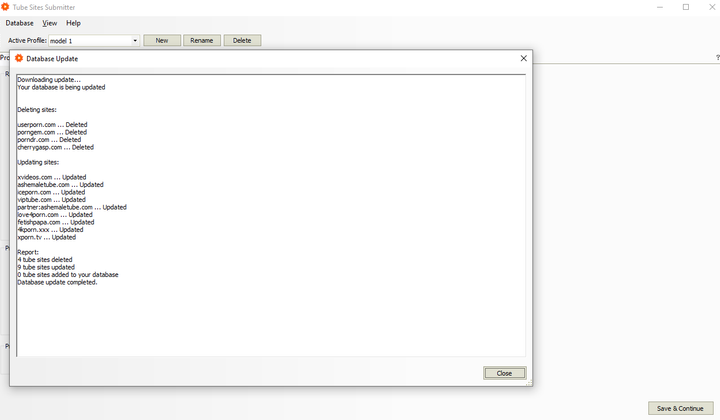
Quick Tip #001 – Keep Your Tube Sites Database Up to Date
The Tube Sites Submitter database is updated several times a week to keep up with changes across supported…
Read post
SexyJobs.com: What Is It and How Does It Work?
If you are looking for jobs, talent, or business opportunities in the adult entertainment industry, you may have…
Read postTry Tube Sites Submitter
Manage your profiles, prepare your content and automate repetitive tube-site submissions.
Windows desktop application